What do we do when our world is falling apart?
How can we carry hope and live wisely in the midst of political turmoil, spiritual warfare, and personal tragedy?
What does faithfulness to King Jesus look like as exiles in Babylon today?
Join us for the next ten weeks as we study the story of Daniel, an ancient prophet who experienced his homeland’s brutal downfall at the hands of an enemy empire, the temptation to compromise with the newly dominant culture, and the spiritual struggle to trust God and love others in the midst of it all.
DISCUSSION GUIDES
-
Listen here: Podcast | Spotify
OVERVIEW:
Lorem ipsum dolor sit amet, consectetur adipiscing elit. Fusce ac risus neque. Integer vel arcu eu turpis lacinia tempus. Donec suscipit nulla odio, at cursus est porttitor vel. Maecenas laoreet malesuada nibh nec iaculis. Proin dictum libero nec felis consectetur scelerisque. Ut sagittis dui hendrerit porttitor luctus. Cras dapibus volutpat nulla a bibendum. Phasellus volutpat ex vel massa pellentesque, eget venenatis massa pharetra.DISCUSSION:
Read: Psalm 2; Daniel 1:1-2QUESTION EXAMPLE
Question sampleQUESTION EXAMPLE
Question sampleQUESTION EXAMPLE
Question sampleQUESTION EXAMPLE
Question sample
PRAYER PRACTICE:
Read: -
OVERVIEW:
Lorem ipsum dolor sit amet, consectetur adipiscing elit. Fusce ac risus neque. Integer vel arcu eu turpis lacinia tempus. Donec suscipit nulla odio, at cursus est porttitor vel. Maecenas laoreet malesuada nibh nec iaculis. Proin dictum libero nec felis consectetur scelerisque. Ut sagittis dui hendrerit porttitor luctus. Cras dapibus volutpat nulla a bibendum. Phasellus volutpat ex vel massa pellentesque, eget venenatis massa pharetra.DISCUSSION:
Read: Daniel 1:3-8aQUESTION EXAMPLE
Question sampleQUESTION EXAMPLE
Question sampleQUESTION EXAMPLE
Question sampleQUESTION EXAMPLE
Question sample
PRAYER PRACTICE:
Read:

ADDITIONAL INFORMATION
-
God created humanity to bear his image and rule his world under his good reign. But humanity rebelled, and the result was disorder, death, and exile from God’s presence.
God then called Abraham and made a covenant with him: through his family, God would bring blessing to all nations. Abraham’s family became Israel, whom God rescued from slavery in Egypt and called to be his covenant people—a kingdom meant to reflect God’s rule among the nations.
Israel eventually became a kingdom under David. God promised that David’s house and kingdom would endure, pointing toward a coming king whose reign would be established by God.
But Israel repeated humanity’s rebellion. The kingdom divided, injustice and idolatry spread, and despite the warnings of the prophets, Israel broke covenant with God.
The northern kingdom fell to Assyria. Then, in 586 BC, Babylon destroyed Jerusalem and the temple and carried Judah into exile.
Daniel begins here.
God’s people are living in exile. Jerusalem has fallen. The temple is gone. Babylon appears to rule the world.
But the question of Daniel is not simply, How will God’s people survive in Babylon?
It is: Who truly rules the kingdoms of the world—and will God remain faithful to his covenant?
-
The Bible was written primarily in Hebrew, Aramaic, and Greek, reflecting the changing world in which God’s people lived.
Hebrew is the primary language of the Old Testament and the language of ancient Israel. Most of the Old Testament, from Genesis to the Prophets and Psalms, was written in Hebrew.
Aramaic became an international language across the ancient Near East. Under the Assyrian, Babylonian, and especially Persian empires, it served as a lingua franca, a common language used among peoples who spoke different native languages.
Daniel reflects this multilingual world. The book begins in Hebrew (Dan. 1:1–2:4a), shifts into Aramaic (2:4b–7:28), and then returns to Hebrew (chs. 8–12).
By the time of the New Testament, Greek had become the common language across much of the eastern Roman world. The New Testament was written in Koine Greek, the widely shared Greek of its time.
The Bible’s languages reflect its story. God’s word moves with his people, from Israel, through exile and empire, and outward among the nations.
-
Daniel moves through two major sections: court tales (chs. 1–6) and apocalyptic visions (chs. 7–12). But underneath that division is a carefully arranged structure.
Daniel 1 — Introduction: Exile in Babylon
Daniel 2–7 — Aramaic Chiasm
Chapters 2–7 form a chiasm—a mirrored literary structure in which themes introduced at the beginning are repeated in reverse order.
A — Daniel 2 — Four kingdoms → God’s eternal kingdom
B — Daniel 3 — The faithful threatened → God delivers
C — Daniel 4 — Proud king humbled
C′ — Daniel 5 — Proud king humbled
B′ — Daniel 6 — The faithful threatened → God delivers
A′ — Daniel 7 — Four kingdoms → God’s eternal kingdomThe mirrored structure places Daniel 4–5 at the center, where two kings learn the same lesson: earthly rulers hold power only because God permits it.
Daniel 8–12 — Hebrew Visions
8 — Vision of kingdoms
9 — Prayer, exile, and restoration
10–12 — Final vision of kingdoms, conflict, and deliveranceDaniel’s structure reinforces its central claim: kingdoms rise and fall, but God remains King.
-
Many of the stories in Daniel 1–6 can be described as court tales, stories about people serving kings and living within the world of royal power. These kinds of stories were common throughout the ancient Near East. They often feature a wise adviser who faces an impossible problem, political rivalry, false accusations, or even death. In the end, the faithful or wise person is vindicated, while the king and his court discover that their own power and wisdom have limits.¹
Joseph and Daniel
We have already encountered a story like this in the Bible.
The story of Joseph in Genesis 39–41 has striking similarities to Daniel. Joseph is taken from his homeland and brought into a foreign kingdom. He eventually stands before Pharaoh, whose wise men cannot interpret his troubling dreams. Joseph succeeds where they fail, but he refuses to take the credit:
“It is not I; God will give Pharaoh a favorable answer.”
Genesis 41:16Daniel finds himself in a remarkably similar situation. He is taken from his homeland and brought to Babylon, where King Nebuchadnezzar has a troubling dream that his wise men cannot reveal or interpret. Like Joseph, Daniel insists that the answer does not come from his own wisdom:
“There is a God in heaven who reveals mysteries.”
Daniel 2:28The similarities go beyond the basic plot. Genesis and Daniel sometimes use similar words and descriptions for dreams, royal officials, wisdom, and the Spirit of God. This suggests that the story of Joseph helped shape the way Daniel’s story was told.²
The connection also helps us understand Daniel. Joseph and Daniel both show us what faithfulness can look like when God’s people find themselves far from home and living under the authority of foreign rulers.
Living Faithfully in Babylon
The court tales in Daniel usually place Daniel and his friends in one of two situations. Sometimes there is a problem no one can solve. The king has a dream or encounters a mystery, his advisers fail, and God gives Daniel the wisdom to understand it.
At other times, there is a conflict that threatens their faithfulness. Shadrach, Meshach, and Abednego refuse to worship the golden statue and are thrown into the furnace. Daniel refuses to stop praying to God and is thrown into the lions’ den. In both stories, faithfulness leads to danger, God delivers his servants, and even the king is forced to acknowledge God's power.³
These stories are not simply telling us to “be like Daniel.” They are exploring a much bigger question:
How do God's people live faithfully in a kingdom that does not worship their God?
Daniel and his friends do not simply reject Babylon. They learn its language, serve within its government, advise its kings, and seek its good. Their lives reflect Jeremiah's earlier instruction to the exiles to “seek the welfare of the city” where God had sent them (Jer. 29:7).
But their participation has a boundary.
They can serve Babylon, but they cannot worship Babylon.
When serving the king conflicts with serving God, their allegiance to God comes first.
This is one reason scholars have described these stories as offering a “life-style for diaspora,” a picture of how God's people can live faithfully when they are far from home and surrounded by a culture that does not share their faith.⁴
That makes these ancient court tales surprisingly relevant. Most of us will never stand before Nebuchadnezzar or be threatened with a lions' den, but we still face the same basic question. How do we participate in the world around us without allowing that world to determine who we worship, what we value, and where our ultimate allegiance belongs?
Daniel's answer begins with remembering who is actually King.
Empires rise and fall. Human rulers gain and lose power. Babylon itself will eventually disappear. Yet through every change of kingdom, God remains sovereign.
Footnotes
John J. Collins, Daniel: A Commentary on the Book of Daniel, ed. Frank Moore Cross, Hermeneia (Minneapolis: Fortress Press, 1993), 42–46.
Collins, Daniel, 39–41. Collins notes numerous similarities between the Joseph and Daniel stories, including their foreign court settings, dream interpretation, God-given wisdom, and eventual promotion to positions of authority.
Collins, Daniel, 46–49. Scholars sometimes distinguish between stories of “court contest,” where the wise courtier succeeds where others fail, and “court conflict,” where the faithful courtier faces opposition, condemnation, and eventual deliverance.
W. Lee Humphreys, quoted in Collins, Daniel, 50. Collins develops this idea further, describing the tales as presenting active participation in life under foreign rule while refusing compromise with idolatry and the distinctive demands of faith in God.
-
tem description
-
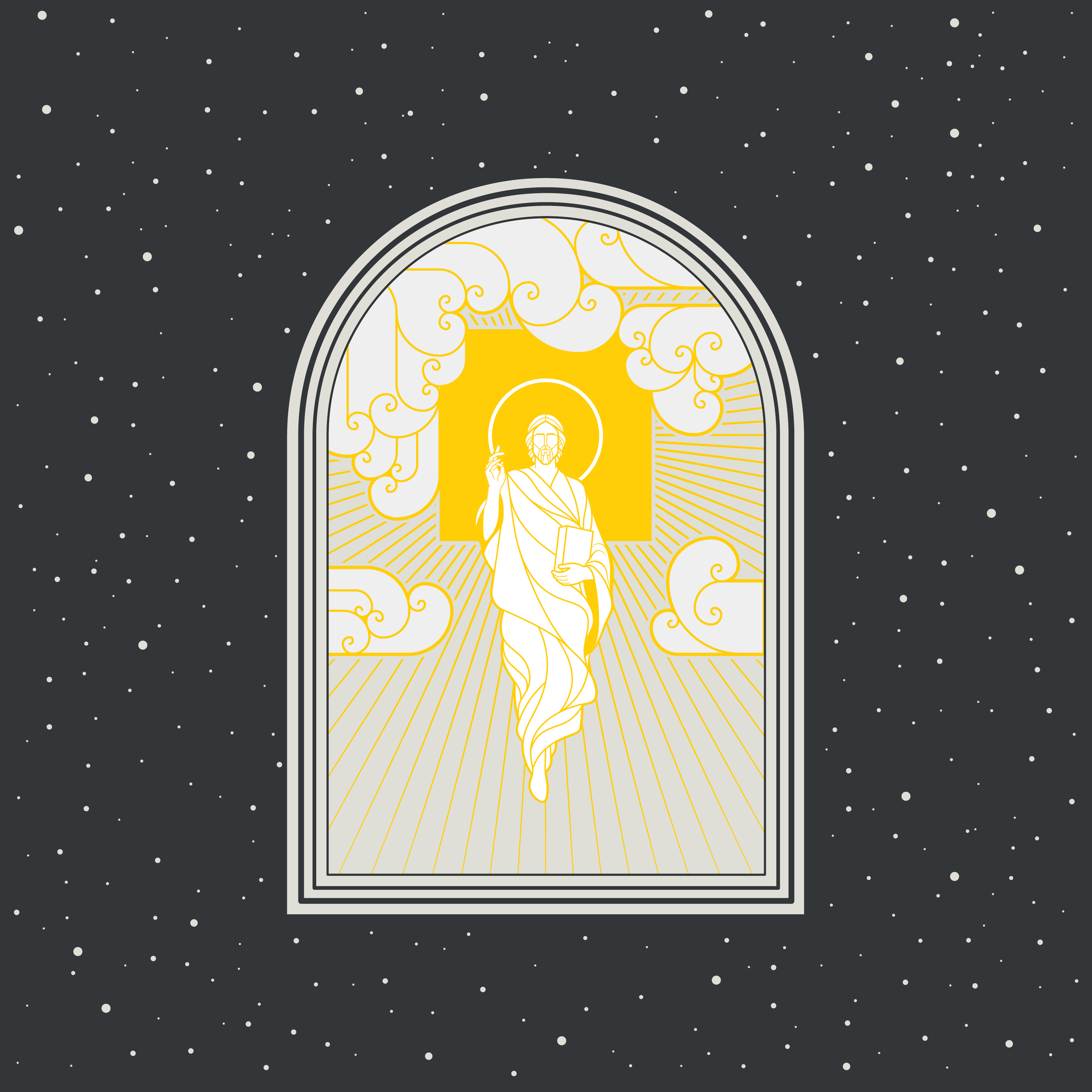
The Book of Daniel sermon series art grew out of a close reading of Daniel and the ancient world in which its stories and visions take place. Rather than illustrating a single scene, it carries a visual language drawn from across the book: the kingdoms of Daniel 1–6, the beasts and horns of Daniel 7–8, the architecture and imagery of Babylon, and the Son of Man coming with the clouds.
At the center is Daniel’s vision of “one like a human being coming with the clouds of heaven,” who is given “dominion and glory and kingship,” and whose dominion will never pass away (Dan. 7:13–14). Centuries later, Jesus draws directly from this vision when he stands before the high priest: “you will see the Son of Man seated at the right hand of Power and coming with the clouds of heaven” (Matt. 26:64). His accusers immediately condemn his words as blasphemy and declare him deserving of death (Matt. 26:65–66). Daniel’s vision therefore becomes a pivotal image in the Gospel account, as Jesus identifies himself with the Son of Man whose kingdom will outlast every earthly empire.
The surrounding imagery reaches further into the world of Daniel’s exile. The horned beasts are inspired directly by the aurochs, extinct wild bulls associated with Adad, the Babylonian god of storms and rain, whose images once lined Babylon’s Ishtar Gate. In this way, Daniel’s apocalyptic beasts are brought into conversation with the actual religious and imperial imagery of Babylon. These paired beasts frame the composition like guardians of a sacred realm. But what they guard is a false Eden, an empire constructing its own vision of sacred order, security, and permanence. Their position deliberately echoes the cherubim stationed at the entrance of Eden, guarding the way to the tree of life after humanity’s exile (Gen. 3:24).
That echo makes Babylon more than a historical setting. It becomes another human attempt to build sacred space and bring heaven to earth on its own terms. It is humanity’s version of order and kingdom, beautiful and powerful, yet ultimately unable to overcome exile. Daniel’s visions expose what lies beneath that order. Human kingdoms rise and fall, beasts threaten, and empires claim permanence, but God remains King. Dominion ultimately belongs to the Son of Man and to the kingdom that will never pass away.